How Spaced Repetition Works: Why It Beats Re-Reading
Spaced repetition is not just looking at the same material again. It works by pulling a memory back right before it fades. Here is the simple principle behind forgetting curves, active recall, and review intervals.
How Spaced Repetition Works: Why It Beats Re-Reading
When people first hear about spaced repetition, they often reduce it to a very simple idea:
look at the same thing again later.
That is not completely wrong, but it misses the real mechanism.
What makes spaced repetition effective is not repetition by itself. It is bringing a memory back right when it is close to being forgotten.
That is why two people can spend the same 30 minutes studying and get very different results:
- one person keeps re-reading and forgets quickly
- the other reviews with flashcards and still remembers the core ideas weeks later
The difference is not effort alone.
It is the structure of the review.
1. The basic principle: forgetting is the default
Your brain does not store new information in a stable form automatically.
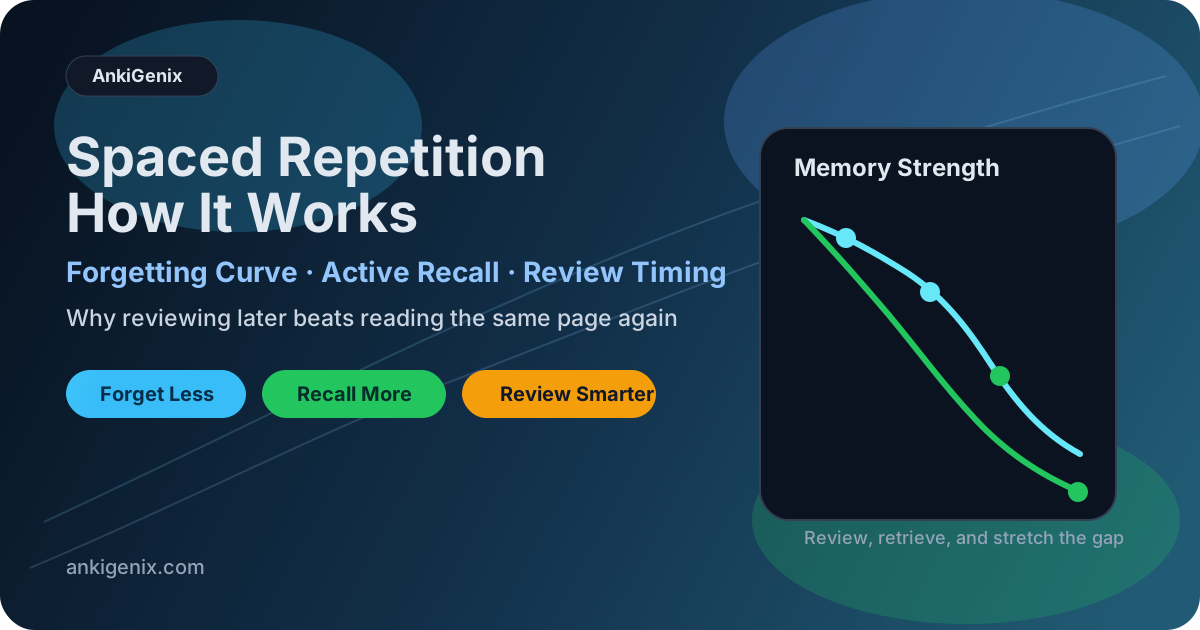
After learning something today, the strength of that memory usually drops over time.
This is the basic idea behind the forgetting curve.
So the real study question is never just "have I seen this before?"
It is:
can I still retrieve it when I actually need it?
If you only review material immediately after reading it, you mostly create familiarity.
It feels easy and recognizable, but that does not mean you can recall it on your own.
2. Why spacing matters more than cramming
Reviews that are too close together create too little memory effort.
If you read something and look at it again five minutes later, your brain barely has to do any reconstruction.
That kind of review feels smooth, but the strengthening effect is limited.
By contrast, if you review right before the memory disappears completely, your brain has to actively pull the information back.
That retrieval is harder, but it is also what reinforces the memory more deeply.
So the point of spaced repetition is not "review less."
It is:
review at the most valuable time.
3. Active recall is the moment where spaced repetition really works
Many people confuse spaced repetition with simply reading notes again the next day.
Those are not the same thing.
Spaced repetition is so often paired with flashcards because flashcards naturally force a sequence like this:
- see the question
- try to recall the answer
- check whether you were right
That middle step matters most.
If you skip retrieval and only re-read, you mostly train recognition.
But long-term memory depends much more on retrieval than on recognition.
4. Why review intervals get longer over time
Every successful recall gives the system a useful signal:
this memory is more stable than it was before.
If it is more stable, it does not need to come back again immediately.
So the next interval can grow from minutes to hours, then days, weeks, or even months.
This is one of the biggest differences between spaced repetition and ordinary memorization:
- ordinary memorization often repeats aggressively in a short burst
- spaced repetition gradually reduces unnecessary reviews as stability improves
In other words, it is not trying to maximize short-term comfort.
It is trying to minimize the total review work needed for long-term retention.
5. Why spaced repetition fits flashcards so well
Many kinds of knowledge can be broken into small, independently retrievable prompts.
For example:
- words and meanings
- concepts and definitions
- formulas and usage conditions
- events and key facts
Once the material is turned into atomic cards, it fits naturally into a loop of question, recall, correction, and delayed review.
If you are still extracting points manually from PDFs, lecture notes, or long reading material, that process can be slow.
A more efficient workflow is to turn source material into structured flashcards first, then let the review system handle timing. For example, start with Text to Flashcards or PDF to Flashcards.
6. Why it feels slower at first but saves time later
Spaced repetition spends time on material that is close to being forgotten instead of giving equal attention to everything.
What you already know well does not need to appear every day.
What you keep missing deserves more frequent return.
That changes how review time gets allocated:
- easy material appears less often
- difficult material appears more often
- total review time gets used more efficiently
So the benefit is not only stronger retention.
It is also less wasted repetition.
Final takeaway
The principle of spaced repetition can be reduced to one sentence:
right before a memory is lost, active recall strengthens it again, and as the memory becomes more stable, the next review interval can grow.
That is why spaced repetition usually beats repeated re-reading.
It does not just increase repetition. It optimizes timing and retrieval effort.
Once you understand that principle, the next step is not simply to study more.
It is to turn knowledge into cards that are easy to retrieve, and let a review system schedule them over time.